

Copyright 2008-2012 Alex Sheshunoff
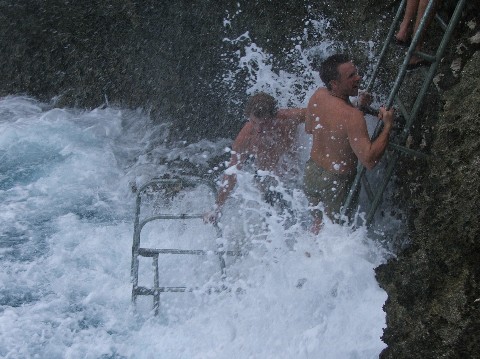
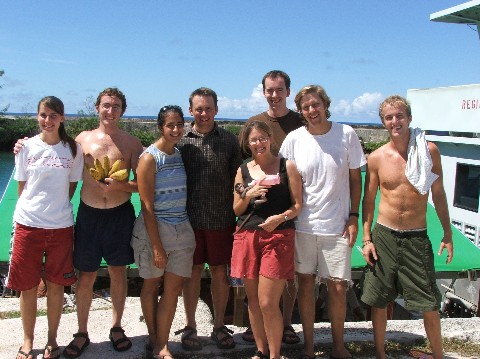
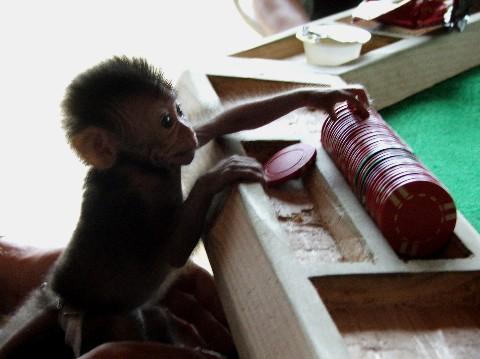
Monkey Photos
Construction Photos
People Photos
Island Photos
Site Photos
House Photos
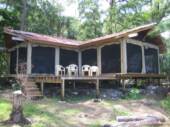
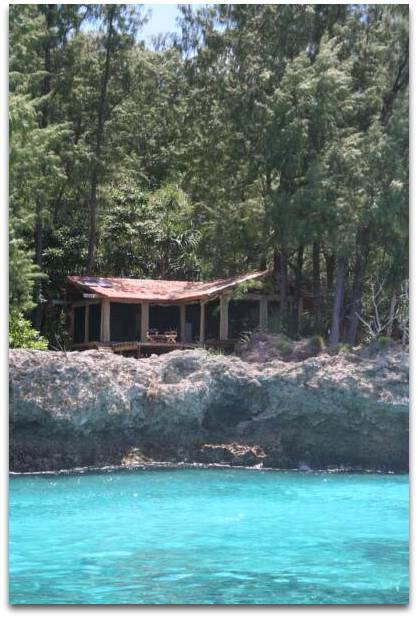
Modeled on an African safari lodge, this 1,200 square foot house uses local hardwoods, canvas, and an open plan in order to be as close to nature as possible - at times, a little too close. Salt spray blows through the bedroom. Five-foot long, monitor lizards ander through the living room. Monkeys, including our pet, Gomez, rummage through the kitchen cupboards.
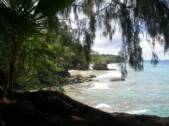
But the little property does have some nice features, including it's own sliver of beach, fantastic snorkeling, a water catchment system, and an outdoor shower with views up and down the coast. The closest neighbor is over two miles away.
Building it involved, among other awkward things, mailing ourselves 12,500 screws and digging 44 holes two feet into compacted limestone - without power tools. The holes alone took us a month. Even with the seven friends we imported to help us build.
"Welcome to paradise," was a sweaty refrain as we whacked crowbars into rock, "Welcome to paradise."
To Visit: According to the terms of our lease, we are not allowed to rent it out, but there are two great ways to go...
PHOTOGRAPHS
Insert Headline
About this information: I'm an American who lived in Palau for about a year and a half and wrote an occasionally funny book about it. I get a fair number of folks looking for travel advice for Palau (when to visit Palau, where to stay in Palau, etc.) so I just decided to post it online here.
All of the below is just my opinion. For more of the party line, visit the Palau Visitors Authority's website.
Where is Palau?
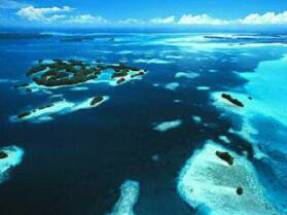
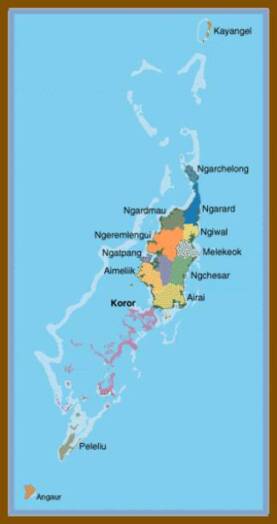
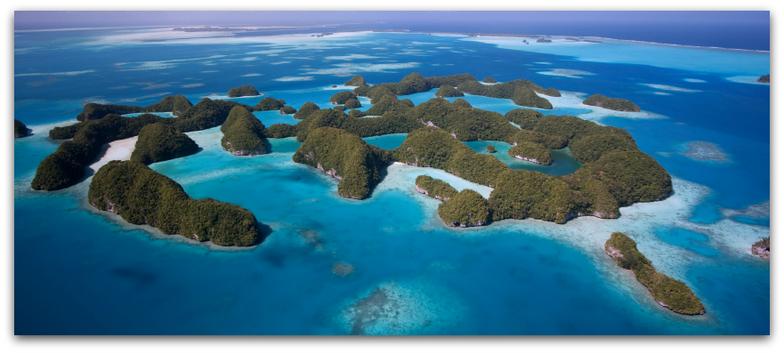
Palau is an archipelago of about 300 islands of which only 9 are inhabited. The total population is about 25,000 people. The island group is located about 1,000 miles southwest of Guam and 600 miles east of the Phillipines. Though it gained some recognition as the latest set for Survivor, Palau is most well known among marine biologists and avid scuba divers.

About here -->
What are the Rock Islands?
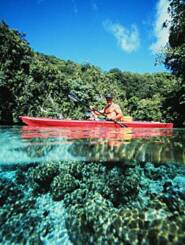
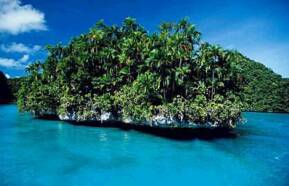
This refers to the chain of 300 or so islands stretching south of the capital, Koror. They're mushroom shaped and occasionally have white sand or white mud beaches. The whole area is spectacular - thank god, they're protected. Two large islands at the end of the chain, Pelelu and Angaur, have a few small villages.
How long should I go for?
When people go on vacation in Palau they usually take a week off from work and spend both weekends. In other words, ten days to two weeks. Plan on spending two days to get there (because of an overnight in Koror) and two days to get back (because of the international date line.)
What is the best time of year to visit Palau?
The only bad month is August when the the water can get pretty rough, making transportation and diving difficult. As such, late July and early September can also be tricky. Once, when the ferry couldn't come to Angaur for a few weeks, we asked the locals what they eat when supplies run low? "Bananas," we were told. "We eat bananas."
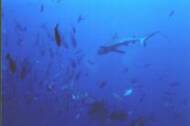
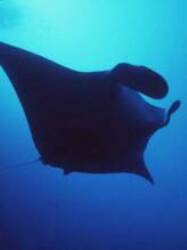
Palau has 1,300 species of fish (compared to Hawaii with 700 and the Carribbean with 350). The diving is most famous for its big sea life - schools of fish, sharks, turles, and manta rays.
How about some background on Palau?
One of the world's newest countries, Palau got its indendence from the U.S. in 1994. They use they dollar, everyone speaks English and Palaun. They keep getting tossed around a bit - first they were a colony of Spain, then Germany, then Japan, then the United States, and now they are independent, though the U.S. still controls their foreign policy. (They even got a brief mention in Michael Moore's Farahenhieit 9/11 for being such a staunch supporter of U.S. foreign policy.)
There are about 25,000 Palauns and almost all are concentrated in Koror. There are a lot of community events - for example, every Tuesday and Wednesdays there is ultimate frisbee, every Monday, Wednesday, and Friday, outrigger canoeing, every other Saturday, a HASH race through the jungle ending at a bonfire with plenty of beer.
In Conclusion...
After having lived in or visited a lot of the Pacific, Palau is still by far our one of the most beautiful places we've been. t's also funky and confusing in ways you'd never expect...
What are the best places to eat in Palau?
There is excellent sushi at Pirate's Cove, terrific Indian at The Taj and good, if expensive, Japanese at Dragon Tai and great fried chicken to go at King's Mart (lunch only).
Where is the best place to stay in Palau?
We think the best place is Caroline's Resort - they have small bungalows with great views. If you stay there, you can also access the beach of the Palau Pacific Resort - which is nice in it's own, mid-80's kind of way, though the beach is man made and you can expect to be with a lot of Japanese tourists on package tours.
What should I bring?
You can buy anything you need but generally at higher prices than in the States. And who wants to spend their vacation in a department store? Here's what you need to bring:
-Mask, snorkel, and fins.
-Tivas or flip flops
-Books
-Shorts and such - it never gets cool enough for jeans.
-Sunscreen
-Light rain coat.
When is the Palauan rainy season?
Palau has some of the most consistent weather in the world - not only from day to night but also month to month. In the dry season it rains once a day; in the rainy season (July-August); it rains twice a day - though almost all the rain tends to come in short, afternoon bursts.
What is Koror, the capital like?
Though not the most beautiful city in the world, Koror is safe and a good place to get groceries and go to restaurants and bars. The downtown area, which wasn’t more than a mile long and a few streets wide, has a scruffy, frontier feel - I imagine similar to that of towns tossed up on the edge of the Brazilian Amazon. Lumber trucks splash through potholes, dump trucks trundle by with loads of men holding shovels and wearing bandanas around their necks, doors of unmarked warehouses slide open and closed, revealing little of their darkened interiors. Best of all, though, you see people from everywhere: Palauans, of course, but also Filipino shop attendants, Bangladeshi construction workers, Taiwanese tourists, and, of course, American lawyers. (Palau bases its legal code on the state of Oregon.)
How do I get there?
There are direct flights to Palau from Guam, Taipei, Japan, South Korea, and the Philippines. Specifically...
- Continental via Honolulu and Guam or via Manilla.
- China Airlines via Taipai, Taiwan.
- Delta/Northwest and Japan Airlines via Tokyo and other Japanese cities.- Asiana Airlines via Incheon, South Korea.
Once in Palau, how do I get to Angaur, the island where your house is?
Twice a week there is ferry service (4 hours) for $5 each way. Chartered speedboats (about an hour and a half) can be arranged for $300. Check with the Angaur State Office in Koror for times.
Photo: Kevin Davidson.
Photo: Bonnie Pelnad.
Photo: Phil Weber
Still have questions?
Feel free to email me at sheshunoff@yahoo.com
Even better, register to get a note when my book about building a house on an outer island of Palau comes out. It's not too long and it has a lot of jokes, several of which are funny. NEW! Provide your email address below and also enter a chance to win a two-week stay at our little house.
Click here to read about the PBS special on Palau called Living Edens.
(Note: I will never ever give or trade your email address. That would be shitty.)
o
<-- Angaur
VISITING PALAU

A little more about building the house...
Based on the idea that anything you do yourself, whether it's making dinner or babies, is more meaningful than just buying it, my wife, Sarah, and I decided to build a house. We lacked only skill, money, labor, and land...
For skills, we signed up for one of Home Depot's free building classes. After two hours a man missing at least a thumb taught us how to build a lovely flower box. Skills - check.
With only a small budget to work with, we decided to build abroad, specifically an outer island of Palau in the western Pacific where we used to spend weekends together. Out there, we thought we could avoid the kind of extra costs associated with things like walls and building codes. (We figured zip-up canvas would substitute for walls; hope for engineering.)
For labor, we sent an email to everyone we'd ever met asking if they'd like to help us build. The subject line - "Swiss Family Robinson Meets the Jackson Five" - must have worked. About a dozen friends would eventually come out to help us.
Finding land was the most difficult. Foreigners aren't allowed to own property in Palau or just about anywhere else in the Pacific but they can lease. It took us months of negotiation with an extended clan and the blessing of the island's matriarchs and chiefs, but we eventually secured a twenty-year lease on a few acres of coastline.
Turns out the hardest part of building was simply getting supplies to the site - the closest hardware store was 75 miles away - by boat - and frequently out of such basics as ladders and wheel barrows. Once to the island, we still had to carry the supplies across - usually by bike.
Five months later, we had a house. Or at least a bungalow. Or maybe just a deck with a roof, but at least we could take a hot-shower by the sea (thanks to a water-catchment system, two solar panels, a car battery, a little pump, and a propane heater.)
Though a good experience, next time we'll probably just buy a house. Or even better, rent.
Palau Island Home
Caretaker Position
UPDATE: Sadly, this house was recently severely damaged by a typhoon. We'd like to rebuild it. If you have building experience and a desire for adventure, let us know. We'd pay for materials but you'd have to pay your own living and travel expenses. But afterwards, you'd have a house to live in! Anyway, here is the old ad...
We are looking for a caretaker, ideally but not necessarily, a couple, to look after our house on Angaur, an outer island of Palau, a former-U.S. territory located about 1,000 miles south of Guam. This is a difficult, challenging, and unpaid assignment not dissimilar in its intensity and remoteness to the Peace Corp. Primary responsibilities include general maintenance, maintaining good relationships with the community and preparing for visitors. The minimum commitment is one year. A small stipend is available to offset personal expenses.
1.) HOUSE MAINTENANCE
The main responsibility of the caretakers is to keep corrosion and termites at bay. The salty air causes extensive corrosion and is a constant problem for metal brackets, solar panels, water pumps, the propane refrigerator, etc.. Termites are the other big concern. Tree branches must be trimmed, and termite spray applied to the posts below the house on a regular basis. Non stinging wasps also constantly build their nests so these need to be removed daily.
2.) COMMUNITY RELATIONS
As we are guests on their island, it is ESSENTIAL that we have a good relationship with everyone on Angaur. This means, for example, that when the ferry arrives you need to be there to help people unload. If you’re not there, they will remember it. Though there are only about 80 people living on the island (all English speaking), there are also weekly events at which your attendance may be expected. These range from birth ceremonies to funerals, chief swearing in ceremonies to school painting days.
3.) VISITORS
When we or our friends come out to visit (about four times a year) you will need to remove all your personal items and move (at our expense) to a rental house (with air conditioning and cable!) on the other side of the island and generally tidy up before and after guests arrive. Most folks will not stay over two weeks but it is essential that all systems (hot water, fan, refrigerator, etc) be working properly before they arrive.
About the Living Conditions
This is definitely off-the-grid living. We use propane to power a refrigerator, freezer, and hot-water heater. Solar panels and batteries run a water pump, small overhead lights, and a fan. There is a composting toilet (that works surprisingly well) and running water for the kitchen and outdoor shower near the ocean. There may be cell phone access within the next few months, but we’re not certain we’ll have reception (no one else lives on our side of the island.) Plan on borrowing someone’s phone when you need to make a call. Accordingly, receiving incoming calls will be nearly impossible. For internet, you will have to go to the school to use a VERY SLOW dial-up connection (it’s shared by 16 other schools throughout Palau.) In theory, a satellite phone would solve some of these problems but at considerable expense. Also, there is no car so you will need to either buy a car (and bring it out on the ferry) or use bikes (which we relied on for four months during construction.)
This is an unpaid position so you will need some savings before heading out. Beyond air fare (flights from the U.S. cost about $1,300), food will be your primary expense. Expect to pay a little more than what you would in an average-sized city in the United States. In season, you will probably given lots of fruit by people who live on Angaur. The cost of the ferry from the capital is $5 each way. Note too that Koror is not exactly a major metropolis. There are no stop lights, movie theaters, or book stores. It's two large grocery stores will put dsphone-placed orders on the ferry for you.
About the Remoteness
Though stunningly beautiful we cannot emphasize enough that this is a REMOTE Pacific island. We define remoteness as distance from definitive medical care. There is a nurse on island but we don’t know how thoroughly trained he is (he's new) but we do know the office is not well equipped. An emergency boat ride to the capital (1.5 hours away by speed boat) can be arranged (for $300) but not at night and not in rough weather. Even in the capital, seventy-five miles away by boat, medical services aren’t reliable. For good medical care you will need to go either to Guam or better yet, Honolulu. The best solution, therefore, is not to get sick or hurt.
Also, sometimes the water is rough and the ferry can’t enter the harbor for weeks at a time. Other times, the ferry leaves the capital only to have to turn around at the entrance to the harbor and make the four-hour trip back in hope of trying again the following day. Access to Angaur is especially difficult from about late July to early September so you will want to stock up on food, just in case. There are no restaurants or hotels on the island – only three very basic stores that sell mostly beer and betelnut.
During the four months we built the house, only one tourist visited the island – a once-famous Japanese sumo wrestler who stayed only for the afternoon. Currently, no foreigners live on the island. There was a U.S. Peace Corp but finished her assignment last November. (This May she is marrying a friend of ours who helped build the house!) Though sophisticated in many ways, only a few of the locals have been to college. Many are wary of new people until they get a feeling for what you’re like.
About the Weather
Having built the house ourselves we know first hand how hot and humid the island can feel. By hot we mean 85 to 90 degrees and 80-90% humidity – day and night, year round. Though a fan helps cool things, there is no air conditioning (the walls are made of canvas imported from a South African safari tent manufacturer) and you’ll need to use a mosquito net. (Mosquitoes aren’t a problem during the day but they do come out for about half an hour in the evening. Fortunately there is no malaria in Palau but there is occasionally dengue fever.)
About the Island
We’ve lived on various islands in the Pacific (Yap, Fiji, The Cook Islands, and Tahiti) and chose Angaur because we thought it was the most beautiful. The island is eight miles around with hills rising in the center and lakes in between. A path lined with giant banyan trees connects Angaur's five beaches. All of the local residents live in a small cluster of cement houses on the other side from our house. The island is also home to a few hundred monkeys, monitor lizards, and though we have never seen one, saltwater crocodiles.
Our particular site occupies about a quarter mile of coastline. To avoid sand flies we chose to build on a small cliff above the water rather on a beach. That said, access into the water in front of our house is reasonably straightforward. Depending on how ambitious you are, steps could also be built into the water. We spot dolphins almost every morning from bed. The clarity of the water is spectacular and the snorkeling is some of the best we have seen anywhere -expect to see large schools of fish and small reef sharks every time you get in the water.
Who We’re Looking For
The ideal couple will have good mechanical skills and excellent people skills. Though long-term construction experience isn’t required, a working knowledge of electrical systems, pumps, and power tools is strongly preferred. The ability to thrive in a remote setting within a foreign culture is essential. Given the lack of railings, sharp rocks, and the thirty-foot cliffs directly in front of the house, it is not suitable for young children.
It is one thing to visit a place like Angaur for a few weeks but another to live there. Beyond house maintenance, snorkeling, and reading, there is very little to do. We would strongly suggest that you get involved with the local school either by helping them with their computers, by teaching, by coaching, etc.. This will need to be approached delicately, however, because the island’s few teaching jobs are in high demand. There is a danger that you will be viewed as threatening someone’s job, even by volunteering. They are right to be concerned: the third grade, for example, has two students. In the end, it is likely that your time with the locals, especially the kids, will be the most memorable and the most meaningful.
About Us
Sarah and I met on a full-moon kayak ride in Palau in 2001. Sarah was working as an attorney for Palau’s Supreme Court and I was recovering from five years of running an internet company in New York City.
Sarah grew up in San Diego and attended Berkeley for both undergraduate and law school. I’m from Austin, Texas, went to Yale, and got a masters in creative, nonfiction writing from the University of Iowa. We've recently moved back to Alaska where I am finishing my book - a nonfiction book about what happens when you buy a one-way ticket to a small Pacific island and take with you the 100 books you were most embarrassed not to have read during college.
For several years we lived on various islands teaching high school and working for non-profit organizations. In 2003 we moved to Anchorage, Alaska where Sarah worked as a public defender and I started the local chapter of Common Cause, a nonpartisan good government group. After a stint with a marine conservation organization in Baja, Mexico we decided to return to Angaur where, in the fall of 2004, we built the house with the help of a dozen friends. (I wrote a small peace about building it that appeared on the cover of the October issue of National Geographic Adventure.) In the spring of 2004 we got married in Todos Santos, a small town in southern Baja California. We now live in Spain.
To Apply
If you are still interested despite all of the above, please email a cover letter and resume to sheshunoff@yahoo.com (please put “Angaur” in the subject line.) We don't mean to be dramatic about the distance, remoteness, lack of health care and such but it would be unfortunate for someone to end up all the way out there and decide after a few weeks that they'd rather be somewhere with air conditioning and closer to home.
We'll contact the most qualified candidates to arrange a phone interview. Thank you for still reading if you've made it this far.
Warmly,
Alex & Sarah
p.s. - A few questions have come up...
-Can I have a gun?
No. Yikes. There is virtually no crime on Angaur and guns are illegal anyway. Creepy.
-What about mail service?
It is possible. We had 12,500 screws shipped to us during construction. Mail is sent to the Angaur State Office in Koror. Someone there will then put it on the ferry for you. If properly labeled, air mail takes about five days to get to Palau. By the time it works its way through the system, you can count on 2 weeks to get a package. Not terrible, considering where it is.
-Can I bring pets to Palau?
Getting pets out of Palau is pretty straightforward but bringing them in is tricky. The Palauan government is a better source of information.
-How long a commitment are you looking for? How about less than a year?
Well, we are pretty stuck on the one-year minimum. If we had people cycling in and out every few months, it would make it difficult for future caretakers to establish meaningful relationships on the island. Of course, if it was working out, someone could stay on for longer. The Peace Corp. volunteer we know lived on Anguar for 26 months and loved it. We've had six caretakers so far and, with one exception, all seemed to have really enjoyed it and stayed for the entire year or extended. The one woman who didn't underestimated the heat, distance, and isolation and left after a few months.
1.) NEW: I've recently completed a book about Palau and building this house called Paradise Misplaced - it's not too long and it has a lot of jokes, several of which are funny. Just fill in your email address here to get a note when it comes out and enter a chance to win a two-week stay at the house.
(Note: I will never ever give or trade your email address. That would be shitty.)
2.) Apply to be a caretaker... see below for details.
